
Science Corner: Christmas Berry

Geoffrey Benn • December 20, 2023

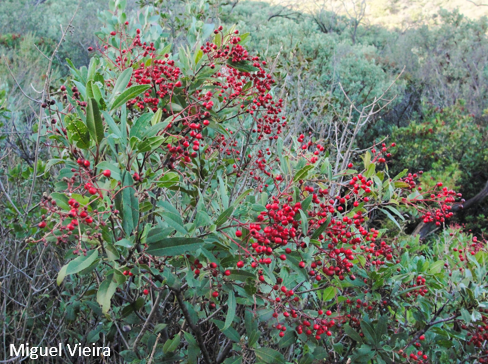
December in the Berryessa Snow Mountain National Monument is a time of muted colors, with the dry browns of late fall slowly starting to give way to the wet greens of winter. One delightful exception to this palette of earth tones is the Christmas Berry, also known as the Toyon (Heteromeles arbutifolia), which bears bright red fruit in the late fall and early winter. The Christmas Berry is a large evergreen shrub that is found throughout the coast ranges in a variety of ecosystems including both chaparral and oak woodlands.


Plants that have evolved in the fire-prone ecosystems of the Inner Coast Range typically utilize one of two strategies for rebuilding populations after fires – germination of seeds dormant in the soil or resprouting from underground root networks. In the case of the Christmas Berry, the aboveground portion of the plant is relatively fire-resistant and may be able to survive low-intensity fires. However, if the top of the plant is killed off in a fire, the Christmas Berry has a strong ability to resprout from its root crown. This ability is critical to its survival, because Christmas Berry seeds are easily damaged by heat and are therefore unlikely to germinate from the soil after a fire.

The fruit of the Christmas Berry have been used by California Indian tribes as both food and medicine. The fruit is somewhat bitter when raw, so it is typically dried or cooked before consumption. Culinary uses include making cider, dried fruit leathers, and inclusion in pancakes. If you’d like to try your hand at cooking with Christmas Berries, you can find a number of different recipes that use their fruit here.


While foraging for wild Christmas Berries may not be for everyone, they also make an excellent addition to landscaping and do particularly well in locations with full sun, where they will provide food for pollinators and birds alike. So, if you find your garden looking a bit drab mid-winter, consider adding some color by planting a Christmas Berry!

RECENT ARTICLES
By Shai Demus • November 17, 2026
Proposed changes to public-land planning could limit community participation and weaken safeguards for Areas of Critical Environmental Concern across the West.
By Nate Lillge • November 10, 2026
Tuleyome, the expert organization on the Berryessa Snow Mountain National Monument, is offering a multi-week Certified California Naturalist course in early 2027. Instruction focuses on the Berryessa Snow Mountain National Monument region while providing participants with skills and resources that are applicable anywhere to increase their knowledge, understanding, and enjoyment of the natural world. The Certified California Naturalist course is presented by Tuleyome in partnership with the University of California Agriculture and Natural Resources. This 8-week course is offered from January to March in 2027, with classes occurring on eight consecutive Fridays plus at least three field trips. Friday classes will be held in downtown Woodland with field trips to northern Inner Coast Range Mountains and western Sacramento Valley. No advanced degrees or previous naturalist experience is required. The UC California Naturalist Program introduces Californians to the wonders of our unique ecology and engages the public in study and stewardship of California’s natural communities. The program uses a science curriculum, hands-on learning, problem-solving, citizen science, and community service to instill a deep appreciation for the natural communities of the state and to inspire individuals to become stewards of their local resources. In addition to in-person instruction, students are required to attend field trips in the Berryessa Snow Mountain National Monument region. Field trips consist of low-impact walking trips and auto-tours, so they are suitable for all fitness levels. Impromptu walks are also often provided by the instructors as time permits to give participants even more experience in the field. More information is available on our website . Questions about the course should be directed to Nate Lillge at nlillge@tuleyome.org .
By Nate Lillge • November 10, 2026
With the arrival of cooler temperatures, Tuleyome has been able to get people outside to enjoy the Berryessa Snow Mountain National Monument Region. Cowboy Camp, located a mile south of CA-20 on CA-16, is a great starting point for anyone exploring the BLM-managed lands between Cache Creek and Bear Creek. As it's name suggests, it is very popular with equestrians but is also a great place for bird watchers, hunters, hikers, mountain bikers, and astronomers. In October, Tuleyome's Program Director, Nate Lillge, led a small but adventurous group on a 9-mile hike through Craig Canyon and Thompson Canyon. Despite hearing reports and seeing signs of Tule Elk, the herd remained illusive. True to the areas name, however, many horses were seen on the trail and in Bear Creek. Pictures from the hike are available on Flickr . Tuleyome co-founder and member of Tuleyome's Advisory Council, Andrew Fulks led a crew at Valley Vista Regional Park to continue our trail work with Yolo County. We were excited to be joined by seasoned trail crew members and gratefully surprised that Bob Schneider, another co-founder and member of Tuleyome's Advisory Council, joined us! Check out the workday photos here . Be sure to check out our upcoming events ! We look forward to seeing you on the trail soon!