
Enjoying Outside! Rattlesnakes!

Kristie Ehrhardt • August 7, 2026

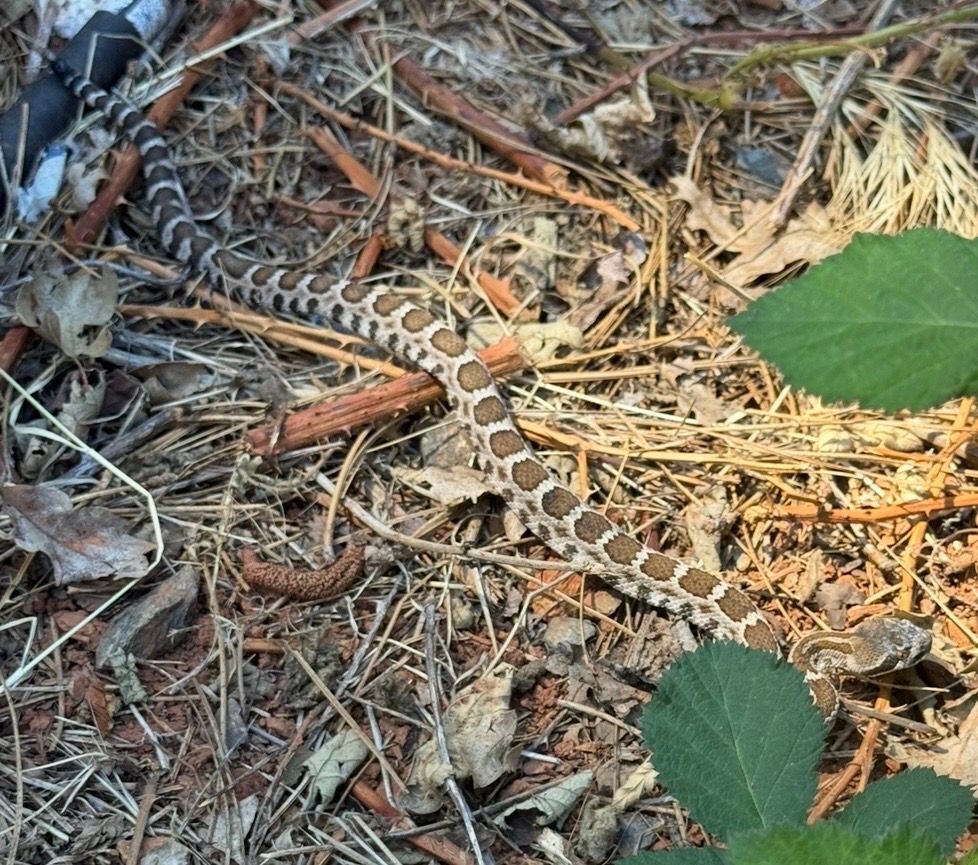
California is home to about 50 different native species of snakes. Some of the more commonly observed species include gopher snakes, California king snakes and rattlesnakes. Included in those 50 species are seven species of rattlesnakes found in California and most of their ranges are defined by our diverse geography. These include the Mojave rattlesnake aka Mojave green (Crotalus scutulatus) found in the desert and foothills of southeastern California. The Panamint rattlesnake (C. stephensi) are found in the high, inland deserts of northern portions of Southern California. The Red-diamond rattlesnake (C. ruber) is found south of Los Angeles to Baja California. Sidewinders (C. cerastes), sometimes called horned rattlers because of the raised scales above each eye that look like horns, are the smallest rattlesnake in California and are found in Southern California deserts from below sea level to about 6,000 feet. Speckled rattlesnakes (C. mitchcellii) are found in the Colorado, Mojave and Sonoran Deserts of Southern California south to Baja California. The Western diamond-backed rattlesnake (C. atrox) is relatively rare within its range of far southeastern Southern California. The Western rattlesnake (C. oreganus) is the most common and wide-ranging species of rattler in California. They are found throughout the state from sea level to about 7,000 feet making it the species most likely to be encountered in the Central Valley, Inner Coastal Range and the Sierra Nevada foothills. 


There are three subspecies of Western Rattlesnakes. The Northern Pacific rattlesnake (C.o.oreganus) is found throughout Central and coastal Northern California. The Southern Pacific rattlesnake (C.o.helleri) is found along the Southern California coast and the Great Basin rattlesnake (C.o.lutosus) which is found in the northern Sierra Nevada. The species we are most likely to encounter in the Berryessa Snow Mountain National Monument region is the Northern Pacific rattlesnake.


Rattlesnakes have large venom glands at the back of their jaw that gives them their distinct triangular-shaped heads and are known for their unmistakable rattling tail. The rattling sound is a warning that they are there and don’t care to be fiddled with. Which is very considerate and convenient seeing as how a rattlesnake bite requires very prompt medical attention.

Rattlesnakes are fairly common on hiking trails and in rural areas throughout the region. They are generally active from April through October and when the weather gets chilly they enter brumation - a period of slow body activity and deep sleep shared by other cold-blooded organisms and me during the shift to standard time in the winter.


Rattlesnakes are born pre-loaded with venom and producing more of it requires energy so the snakes don’t dole it out willy-nilly. Meaning, you’re too big for them to eat so they’d rather not waste the venom on you, hence the warning rattle. However, a threatened snake may bite without the warning sound so when outdoors paying attention to where your feet, hands, and dog are at all times is imperative. The rattle itself is made up of keratin and grows a new segment each time the snake sheds its skin. Older snakes may have several buttons on their rattles or none at all if it’s been broken off so being able to identify them based on other characteristics is important. They can be found in a variety of diverse habitats from the coast to the foothills. They can be found in rural and urban areas, along stream and river banks, in parks, on golf courses, under landscaping and even under trash cans or along retaining walls in urban developments. They take refuge in wood piles, under rocks and in brushy areas and they like open areas for basking.


To minimize the possibility of encountering a rattlesnake, the California Poison Control System and the California Department of Fish and Wildlife recommends that you:

  • Stay on clear, well-used trails and avoid wandering into tall vegetation and thick brush.
  • Always pay attention to where you’re stepping and when encountering a large rock or log, step on top of it to avoid stepping in front of a snake that may be snoozing on the other side.
  • Wear sturdy boots and long pants.
  • Be sure to investigate rocks and logs with your eyes, not your hands, before you have a seat.
  • Hike with a buddy and keep children close.
  • Do not mess with snakes, even if they appear to be dead. Muscle contractions may continue after the snake is dead and bites can still happen.
  • Keep your pets on a short leash to keep them from sticking their noses into places where snakes could be dozing.
  • As always with any hike, leave with a fully charged cell phone, tell others where you plan to hike and what time you plan to return.


If you do encounter the tell-tale sound or a rattler itself on the trails or anywhere else, stop moving immediately and determine where the snake is. Slowly back away and try to maintain a six foot distance (you know how to do this from COVID protocols), big snakes can strike from a substantial distance. Do not touch, relocate or kill the snake, most bites happen when people get too personal with them.


If something terrible transpires and you or someone in your party does get bitten, call 911 immediately and remove constricting things like rings, watches and shoes. Severe and even life-threatening symptoms are possible and can begin occurring within minutes of being bitten. If your dog is bitten, get him or her to the vet as quickly as you can. Administration of anti-venom as soon as possible can save human and canine lives. 


Do NOT:

  • Apply ice or heat to the area
  • Cut or slice around the area (eww)
  • Suck the venom out (this is a gross old cowboy movie myth)
  • Take any medicine or consume alcohol or caffeine
  • Use a tourniquet to restrict blood flow or to contain the venom


Lots of Fun Facts and Side Notes:

  • Sidewinders are named for their sideways gait; their method of locomotion reduces the time that any one part of their body is in contact with the hot sand.
  • Did you know that there is an approved rattlesnake vaccine for cats and dogs? Your veterinarian can tell you more.
  • There are also canine rattlesnake aversion training classes. Ruben and I are enrolled for one in August, shoot me an email if you’d like information on it.
  • Do you know the difference between a venomous animal and a poisonous animal? If it bites or stings you it’s venomous (rattlesnakes, spiders) and if you consume, inhale or absorb the toxin, it’s poisonous (toads and newts).
  • Although they lack venom and fangs, an agitated gopher snake can mimic a rattler by flattening its head and vehemently shaking its tail. Bless their little three-chambered hearts for trying so hard to be scary.
  • California king snakes not only eat rodents but they also consume rattlesnakes and are unbothered by their venom.
  • All rattlesnakes have temperature-sensitive “pits” (hence the name pit viper) on each side of the head that allows them to locate prey in the dark.
  • Rattlesnakes along with several other species of snakes are live bearers meaning they don’t lay eggs but give birth to several tiny snakes. The babies stay with momma and she cares for them for one to two weeks after birth.
  • Rattlesnakes can swim!


All snakes, including rattlesnakes, play an integral role in our ecosystems and contribute to a healthy and diverse environment. Leaving them to their work is the best thing for everyone. If you need a rattlesnake removed there are services that will come catch and relocate the snake.

RECENT ARTICLES
August 7, 2026
Our wildest areas are under threat. In June, the Administration moved to weaken protections for our wildest public lands - those designated as wilderness, Wilderness Study Areas, Lands with Wilderness Characteristics, and recommended Wilderness. What do these areas represent? Millions of acres of untrammeled backcountry. The Department of the Interior, US Forest Service and National Park Service initiated the first step in unraveling these protections. They’ve called for a “review” of eight policies, opening the door to weaken protections and paving the way for short-term extractive industries, commercial development, and resource fragmentation at the expense of long-term conservation management of some of our wildest remaining public lands. Nearly 200 million acres of wildlands across the west could be impacted by this review, including approximately 120 million acres of Wilderness Study Areas and wilderness quality lands, and 75 million acres of designated wilderness areas. This includes the nearly 94,000 acres in Cache Creek, Cedar Roughs and Snow Mountain Wilderness areas in Berryessa Snow Mountain Nation Monument right here in our own region. These policies guide how federal agencies identify, manage, and steward designated Wilderness Areas, Wilderness Study Areas, and lands with wilderness characteristics. Together, they influence the management of millions of acres of federal public lands and translate statutory requirements into day-to-day management decisions. Continuing to protect wilderness qualities is consistent with protecting recreation. In many cases, wilderness-quality land provides the best opportunities for backcountry recreation; a CA outdoor industry responsible for 545,448 direct jobs valued at $38.1 billion. The total value-added worth of CA outdoor recreation is $81.5 billion, 2.2% of our gross domestic product. The Department of the Interior’s actions present a false choice between stewarding wilderness lands and providing opportunities for recreation. Let’s tell the Administration that we oppose these rollbacks and are committed to protecting our wild places. Sign on to the Wi lderness Review- National Sign-on Letter opposing five different actions across the three agencies by August 12th. Together, we can show this administration that we care about protecting these special places today and into the future. Sandra Schubert Executive Director
August 7, 2026
I first heard about Tuleyome when I retired early from UC Davis eight years ago. I was looking for local organizations for volunteer opportunities. I discovered Tuleyome and got connected with Bill Grabert and Nate Lillge. I helped them lead hikes and school programs, then took the CA Naturalist course through Tuleyome. My capstone project was to lead a backpacking trip into the Cache Creek wilderness, which I did just as COVID was descending on us. I was, and still am, impressed at how such a small local non-profit has both ensured preservation of important wild areas and invested heavily in outreach to local schools. Working with kids from Lake County in the Redbud area was eye-opening and extremely gratifying. Some of them had literally never been on a hike in spite of growing up so close to all that spectacular wild land! I donate to Tuleyome to help them keep up the great work!!! I’ve spent countless days hiking in and enjoying the Cache Creek area; what a gem of a local resource! And, only last spring was I able to get up to Snow Mountain…so glad it’s preserved and accessible for camping and hiking. Wow! A wilderness area near my home - that’s amazing. I’m incredibly grateful for Tuleyome’s hard work that resulted in preservation of these important wild places, and I look forward to seeing what’s next.
By Kristie Ehrhardt August 7, 2026
Driving around the Berryessa Snow Mountain National Monument one rainy day revealed a network of dirt roads that were slick as snnn… well, you probably know. The wet weather made driving less than optimal for the Subaru we were in but for our amphibian friends, the low-riding California newt, the warm, misty conditions were sublime. California Newts ( Taricha torosa ) are endemic to California, which means that they are extra special because they are only found here. They occur below 6,000 feet along the Coast Ranges from Mendocino County south to San Diego County. They are also found in the foothills and western slopes of the Sierra Nevada in the San Joaquin Valley with a few isolated populations in southern San Diego County. They utilize both wetland habitat including natural and artificial pools and ponds, reservoirs, creeks and streams for breeding during winter and spring, and upland areas such as chaparral and woodland habitats where they spend summer and fall. California Newts have stubby little toes attached to short, stocky legs. Adults range from about two and three quarters inches to about three and a half inches long, not including the tail. Their bellies and undersides of their neck and chin are bright golden yellow to orange with a reddish-brown to slate gray back. California Newts reproduce from late fall to early summer depending on rainfall amounts and habitat conditions. Adults migrate from their upland refugia to their preferred wetland to breed. Eggs are attached to submerged vegetation or under rocks and females can lay up to six masses of nearly 50 eggs a day. The eggs hatch in two to six weeks depending on water conditions and temperature. Larvae are aquatic and have gills and fins. After several months the larvae begin to exit the pond and set about metamorphosing into adults and do not return to the pond again until they are ready to breed. Larvae eat small aquatic invertebrates and organic matter; adults eat insects, slugs, snails and worms as well as other amphibian eggs and larvae. Adult California Newts are highly toxic. Like other members of the genus Taricha , adults have glands on their skin that secrete the potent neurotoxin tetrodotoxin - the same toxin that is found in harlequin frogs and pufferfish. Side note, this makes them poisonous rather than venomous (like rattlesnakes). Tetrodotoxin is hundreds of times more toxic than cyanide and potent enough to kill most vertebrates. The toxin affects sodium channels and makes it so neurons are unable to fire which results in lethal muscle paralysis. One of the only predators of adult California Newts are garter snakes. Garter snakes are one of the very few organisms that have evolved to develop a resistance to the tetrodotoxin produced by the newts. Garter snakes can ingest the toxic newts with limited effects which has created an evolutionary arms race (coevolution). As the garter snakes develop stronger immunity to the toxins only the most poisonous news survive which in turn results in future generations of news with even stronger toxins. This leads to a population of garter snakes that have developed a resistance to the stronger toxin levels and and on it goes. Loads of them were bumbling along the edges of the wet dirt road that rainy day. We made several stops to relocate those that were attempting to cross but seemed to stall out in the middle, always placing them facing the direction they were aimed. I don’t know if they were heading out to their natal ponds to mingle and breed, or on their way back to nap in their upland refugia but they were definitely enjoying the day. The California Newt is currently a California Species of Special Concern due to habitat loss and invasive non-native species introduction which makes seeing so many of these little stumpy legged tetrapods enjoying the Monument even even more groovy!