
Monumental Questions - What is iNaturalist?
Kristie Ehrhardt • April 9, 2026

Have you ever been hiking in the Berryessa Snow Mountain National Monument (or almost anywhere else in the world for that matter) and come across a plant or animal and not been able to identify it? Have you ever thought, “hmmm, if only there was an easily accessible phone app that could help me identify this thing nearly instantly?” If that exact thought wandered through your cranium; boy, oh boy are you in luck! Enter iNaturalist! 


The iNaturalist app is primarily an online social community sharing their findings and information to network and help others learn about the environment. The iNaturalist website states that “INaturalist is crowdsourced species identification system and an organism occurrence recording tool. You can use it to record your own observations, get help with identifications, collaborate with others to collect this kind of information for a common purpose, or access the observational data collected by other iNaturalist users.” 


 iNaturaist was developed as a Master’s final project by Ken-ichi Ueda, Nate Agrin and Jessica Kline at UC Berkeley’s School of Information back in 2005; the same year that YouTube and Reddit were initially introduced to the public - a vintage year for social media developments! It officially launched in 2008 and work continued on the site and iNaturalist, LLC was born in 2011. By 2017 National Geographic was onboard and in 2023, what began as a student project became an independent nonprofit organization that grew into a globally recognized Citizen Science driven platform that connects millions of people to the biodiversity around them. iNaturalist is a compilation database that contributes valuable collective intelligence to conservation and science from around the world. iNaturalist is a valuable tool for species identification as well as organism occurrence  crowdsourced information, it is also a practical resource for species identification and distribution. And guess what else! It’s free to use.


Sound good? Want to know how you can benefit from iNaturalist? 

You can use iNaturalist to record your own species observations and locations. You can use it to help identify species you aren’t sure about or may be new to by using other individuals' entries. You can even work with other users to collaborate and continue to add information to the site or you can access other’s information regarding species observations and occurrences. You can look up and enter data using scientific nomenclature or common names. You can look at other’s photos and locations for reference and contribute your observations. Students and Professors alike are using and recommending iNaturalist. 


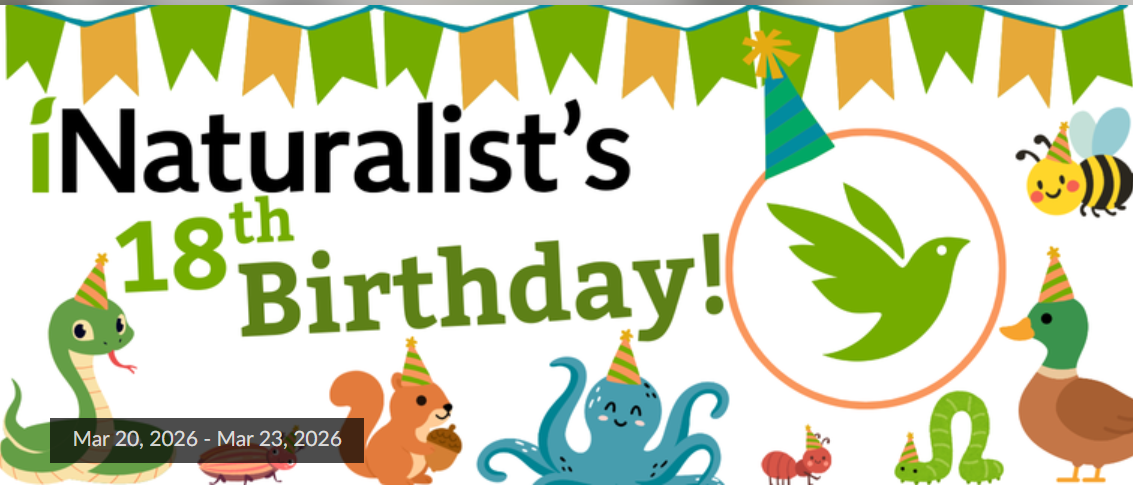
So how’s it been going? On March 20, 2008, the very first entry was made into iNaturalist. To save you from doing the math I’ll tell you that iNaturalist just had its 18th birthday! Guess how many observations people have recorded in those 18 years… you’ll never guess so I’ll just tell you - iNaturalist has over
3.5 million individual observations! And it’s increasing every moment, you can literally watch the counter on their homepage rise. Guess how many individual species have been recorded! Not to be disparaging but you’ll never get it...iNaturalist is up to just under 560,000 species! There are currently over four million registered individuals making and recording observations and more than 483,000 people helping other people by making identifications. In just 18 years, a student project has grown into a globally recognized and respected tool to make and record species observations adding information to a world-wide biodiversity database. If you want to be a part of this community simply download the iNaturalist app or go to their website and get out there and start entering your observations. The Berryessa Snow Mountain National Monument region is an incredible place to practice using iNaturalist because it hosts such a huge diversity of habitats and species. 

RECENT ARTICLES
May 11, 2026
 At Tuleyome, we support Public Lands Advocacy, Conservation, Stewardship and Education. Our commitment to these three pillars of action means that we must encourage our supporters to vote and to invest the time to learn how candidates for public office view public lands and public access to those lands. Public lands are a central part of our national heritage and have been so since the very founding of the Republic. The first shots of the American Revolution were fired on public land (the Lexington Common) in 1775. The practice of managing lands for the common welfare is itself tens of thousands of years old and is central to the traditions of indigenous people across all of the Americas. The relatively novel notion of private ownership of land has become prevalent in our society, but that in no way should blind us to the centrality of public land to the health and welfare of all. And yet there are those who would turn every scrap of public land over to private ownership for exploitation if they could. Efforts to privatize public lands or give Federal lands to states, where political pressure to privatize is stronger, have taken on a new urgency. They represent a significant threat to the public’s right to enjoy public lands. These efforts represent an existential threat to nature, wildlife and the land itself, as exploitation of the national legacy for private gain becomes the dominant ideology of certain elements in our society. Fortunately, as citizens, we have the opportunity to educate ourselves about who supports public lands and the public’s right to benefit from public lands. If you want to be a public lands voter, here are the three questions you need to ask everyone who is asking you for your vote: Do you support keeping public lands in federal public ownership, and will you oppose efforts to transfer them to state or private control? What specific actions will you take to improve public access for hunting, fishing, and outdoor recreation? What is your plan to ensure that public lands are managed for a balance of conservation, restoration, recreation and responsible energy development? Public lands, which include our national forests, lands managed by the Bureau of Land Management and Bureau of Reclamation, as well as the national park system, are managed for all Americans. Proposals to sell or transfer these reduce public access and jeopardize wildlife habitat. Ask for a clear commitment to keeping land access public rather than transferring it to state-level management. Ask what your representatives will do to eliminate private land bottlenecks. Ask for concrete plans to improve trails, access points, and habitat connectivity. Public lands are at the center of the climate crisis debate and many voters prefer conservation and renewable energy over increased oil and gas drilling. We support a balanced approach that prioritizes habitat protection and sustainable use, rather than maximizing extraction. This is the kind of long-term legacy that we owe to the people whose land we appropriated. It’s a legacy we owe to the generations of Americans before us who fought to establish the rule of law and the values of republican government. Public lands are the embodiment of the notion that we are a nation of equal citizens, indivisible, and not servants to the economic interests that extract private profit from public resources while socializing private losses on public accounts. If you want to be a public lands voter, take the time to educate yourself by visiting https://www.tuleyome.org/ and then ask those who want your vote the hard questions about where they stand on public lands. Then, Vote! Register to Vote here: https://registertovote.ca.gov/ The last day to register to vote for the June 2, 2026, Primary Election is May 18, 2026. Find your district and voters guide here: https://www.sos.ca.gov/elections Voting by mail in California is safe and secure and really easy to do. You can track the status of your ballot here: https://california.ballottrax.net/voter/ Craig Perrin Tuleyome Volunteer Board Member
By Kristie Ehrhardt May 11, 2026
Maybe you’ve seen some roadkill while driving through the Berryessa Snow Mountain National Monument, along the freeway, or even in your neighborhood. Or maybe you’ve been hiking and caught a whiff of something really, really foul. Or maybe you’ve seen ants swarming on another dead insect or even come upon an animal skull during a day on the trail. Have you ever thought about what happens when an animal dies in nature and how does it “go away”? Enter nature’s clean up crew! Carrion eaters are organisms that eat dead and decaying animals. This can be roadkill, leftovers from other carnivores’ meals, animals that simply expire from old age or injury or those that have been hunted and unfortunately never recovered by their pursuer. It sounds pretty gross but carrion eaters play a critical role in ecosystem nutrient recycling. Sometimes they’re loosely called “scavengers” and one of our most valuable scavenger species is pretty common and can be seen almost anywhere in our region from urban to rural areas. Do you want to take a guess at what species it is? I’ll give you some clues… They have an exceptionally fine-tuned sense of smell and can detect the scent of rotting flesh from over a mile away. Are you jealous? Their stomach acid is ultra acidic and allows them to eat bacteria and virus-laden decaying flesh and still remain healthy. When they feel threatened they will vomit in self-defense. Considering what they eat, it’s pretty clever and effective. It also makes them weigh less so they can escape quicker. To cool off in hot weather they will defecate and/or urinate on their own legs. This is called urohydrosis. They lack vocal cords and cannot make vocalizations, they can produce only grunts and hiss sounds. Did you guess what species I’m talking about yet? Of course, it’s the Turkey Vulture! Their scientific name, Cathartes aura , literally means, “cleansing breeze”. It seems appropriate when you consider their role in removing carcasses that spread disease such as anthrax, botulism and cholera from the environment. Turkey Vultures do not have feathers on their heads and resemble wild turkeys which is where their common name came from. Although their bald, red heads don’t help endear them to those that like “pretty birds”, it does keep them clean while they jam their naked heads into sticky, stinky dead animal carcasses. Although Turkey Vultures are classified as a bird of prey, they do not have strong talons like other raptors and are not able to kill their own food which makes them reliant on carrion left behind by other carnivores, mother nature, or vehicles. Turkey Vultures also do not build nests like most other birds. Instead they lay their eggs on the ground in a sheltered place like a cave, hollow tree, rocky crevice or cliff or even in an abandoned building. I see a lot of Turkey Vultures so apparently that nesting strategy works well for them. California Condors are also carrion eaters and use the same nesting strategy but struggle with success in the wild. Unfortunately poor nesting success and other identified dangers continue to keep their free flying population fairly meager. Turkey Vultures are widely distributed and occur in nearly all of the Americas from southern Canada to the southern tip of South America. It is a permanent resident in the southern United States but northern birds may migrate south. It is found in a diverse range of habitats including deserts, grasslands, farm and rangeland, wetlands, foothills and mountains, as well as suburbia. They prefer open county without dense tree cover where they can easily take flight and enjoy the thermals. While soaring they resemble a dihedral (shallow V) and although they are master fliers, rarely flapping their wings, they appear unsteady by rocking and tilting in flight. Their slow, teetering flight allows them to fly low aiding them in detecting their next meal. Their body feathers are dark iridescent brown-black with highly contrasting silvery-gray flight feathers. Their short, hooked beaks are ivory-white against their bright red heads, juveniles’ heads are black. Their wing span is similar to Bald and Golden Eagles at around six feet and they can weigh over five pounds. The oldest wild Turkey Vulture was 16 while captive birds have lived to be 51 years old. Lead poisoning and outright killing of Turkey Vultures due to the false belief that they spread diseases (in reality they clean up the ecosystem!) are their main conservation concerns. Their population numbers remain strong with a global population estimated to be 18,000,000 individuals. Other interesting Turkey Vulture fun facts include: In the air a group of Turkey Vultures are called a “kettle” but on the ground they go by “committee” or a “wake”. Large groups of them roost together in trees and although I'm not sure what that’s called but that is an impressive sight! Gas and oil companies have been known to employ Turkey Vultures to detect pipeline leaks because the scent added to natural gas is similar to that of decaying flesh that they are so fond of.  Next time you see a Turkey Vulture soaring over our favorite monument, on the way to our favorite monument or even on your way home from school or work, give them a nod for doing a bang-up job of waste management!
By Kristie Ehrhardt May 11, 2026
Did you know that Tuleyome has a hiking equipment lending program for kids?! The idea began as a Boy Scout project back in 2016. Tuleyome collaborated with Davis Boy Scout Troop 111 and so began our Boot Bank! The Tuleyome Boot Bank is a lending program that provides gently used, high quality hiking boots and other camping equipment to kids up until age 18 for FREE! The program was founded as a way to help solve the financial burden on families who wanted to enjoy the outdoors but simply couldn’t afford to continuously buy good quality, well-fitting hiking boots for little feet that just keep growing. As a mom I understand how hard it is to part with a pair of perfectly functional little hiking boots that never fit long enough to get worn-out, just out-grown. One of Tuleyome’s aspirations is to help families enjoy and explore nature and sharing well-fitting footwear is just one of the ways that we can help do that. Initially the boots were loaned out of the back of an antique milk truck that was generously donated to Tuleyome, along with operating costs to help encourage the young program, by one of our favorite supporters. The yellow truck, affectionately nick-named “The Wonder Truck” would visit community events filled with boots of various sizes for various sized little feet. But, unlike the boots, the truck began to wear out and unfortunately parts for a 1967 Divco step van were getting harder and harder to come by. We’ve since retired our “Senior” Boot Bank truck and it can be viewed free roaming at the Woodland Regional Park Preserve where it will live in peace surrounded by nature. Our “Junior” Boot Bank is a little more spry and able to travel at freeway speeds so you might see it around town or even visiting the Berryessa Snow Mountain National Monument. The program began as a kid’s hiking boot “lending library” but has since grown into a program that now includes gear that is available for short-term loan to participants in Tuleyome events such as backpacking or camping trips or to youth-serving organizations that are hosting outings. The gear library includes tents, sleeping bags, hiking poles, backpacks, headlamps and other camping and hiking equipment. The goal of the program is to encourage youth and their families to experience the pleasure of exploring the outdoors and the recreational opportunities offered by Mother Nature. We are hopeful that by participating in positive hiking and camping experiences that kids and their families will develop a love and respect for nature, conservation and public land enjoyment. Thanks to our remarkable volunteers, the boots that Tuleyome loans out are always inspected and freshened up before they are made available for borrowing. Over the years, the collection of boots have been provided through donations by individuals and corporations such as Big 5, REI and Target. If the young members of your family are in need of boots or if your organization needs gear for a trip, visit the Tuleyome office at 622 Main Street, Suite 200 in Woodland during our monthly Youth Boot Bank Office Hours, 2:30pm-5:30pm on the first Wednesday of each month. During office hours you will be able to try on several pairs of boots and check them out, return a pair you’ve already borrowed or donate boots to the program. The Boot Bank is open to anyone 18 and under and provides free loans for up to six months; at which point borrowers can renew or trade up for a larger size if necessary. *User Agreement: Boot users sign an agreement in which they agree to use the boots only for hiking, outdoor adventures and inclement weather; not for everyday use (the purpose of the Boot Bank is to encourage participation in outdoor recreational opportunities, not to meet basic shoe needs). Users agree to return the boots in good condition except for reasonable wear and tear.